Wednesday, October 26, 2011

Beautiful Iwate and Miyagi Prefecture

This past weekend I was able to participate in a government funded tour that went to Sendai city and throughout the Miyagi and Iwate prefectures.  There was a group of about 20 international students from AIU and Touhoku University, most of whom were from Touhoku University in Sendai (There were only three students from AIU that went, including myself and two other Americans).  As you all know this area of Japan was the area that experienced the most severe damage from the March 11 earthquake and tsunami.  The area was not only severely damaged due to the terrible earthquake, but the area has also experienced a severe drop in tourism.  Therefore, the government is conducting a survey to see what can be improved at many of the tourist locations as well as to generate interest in the area and help revive the local economies.  The area itself is absolutely beautiful.  Our tour included many stops and activities including the recently named UNESCO World Heritage site of Hiraizumi.  So, I will attempt to give a brief overview of the places we visited and accompany the descriptions with a brief history of the area as well.  As I cannot give a full history of each site I will place links throughout this blog so that you can easily find more information on the area.

My trip started from Akita City.  I was able for the first time to ride Japan's famous Bullet Train (Shinkansen) from Akita City to Sendai.  The journey takes approximately two and a half hours and covers a distance of approximately 152 miles.  Upon arrival in Sendai, I headed off to meet the staff that had generously prepared the information for us all, Mr. Muroya and Miss Nemoto.  They are absolutely wonderful people and we all had a great time together!  After meeting at the station we walked to a nearby hotel where we stayed the first night.  As we arrived Friday evening, after checking in to the hotel we headed out to dinner.  The city of Sendai is quite famous for a dish by the name of ギユウタン this is pronounced "gyu-tan" and is flavorful, delicious cow tongue.  Along with the cow tongue we ate a variety of different mouthwatering Japanese foods, and of course not to be forgotten drank just the right amount of 日本酒 Japanese sake.  After an enjoyable night of Japanese tongue twisters, jokes, good food, sake, and splendid company we returned to the hotel for a bit of sleep before the start of the weekend's journey.


Saturday started with a journey to the recently named UNESCO World heritage site of Hiraizumi.  The area is full of National historic sites including the Konjikido (Golden Hall), Pure Land Garden of Motsu-ji Temple, the Chuson-ji Temple along with many others.  We first stopped at the information center on the way into the area to learn more about what we would be touring that day.  After viewing some artifacts and reading about the history of the area we set out to the Chuson-ji Temple.

The area of Hiraizumi is especially famous due to the efforts of the first Oshu Fujiwara lord, Kiyohara.  A man who's childhood was marked by the violence of war and the destruction of his family due to it.  Kiyohara had a vision to create an area of Japan that was founded on the principles of the Buddha and to honor and make peace with those that had died in the Nine Year's War (1051-1061) and the Three Year's War (1083-1087).  Therefore the area was developed with meticulous detail to the balance of the natural world.  Hiraizumi geographically was an area that was rich with gold during that time, and as the area developed it became a center for trade.  Artifacts from the area include shells and ivory that traveled on the Silk Road and made a final stop in Hiraizumi.

The Chuson-ji Temple has numerous halls and gardens surrounding it.  One of the halls is the Konjikido or the Golden Hall.  The all-gold hall was completed in 1124.  It is covered in gold , silver dust, intricate metal work, mother-of-pearl, and was built with ornate craftsmanship.  The central dais is where the body of Fujiwara no Kiyohira was laid to rest.  Morohira was laid to rest in the left facing dais, Hidehera and Yasuhira were laid to rest in the right dais.  The shimmering gold and two of the four heavenly kings, Jikokuten and Zochoten protect those laid to rest.  The beauty and detail of the Golden Hall was unbelievable.  As pictures were not allowed to be taken, please click the following link to learn more about this incredible treasure: The Golden Hall  I also highly recommend you to visit the following and explore the site as it gives greater insight and context to the unique and special history of the area: More on Chusonji.

While a fire in 1337 destroyed many buildings, the Golden Hall and more than 3,000 National Treasures and Important Cultural Properties survived.  Due to Kiyohara and his vision as well as his successors the area of Hiraizumi flourished and experienced a period of 100 years of peace.  The history of the area is quite incredible and the amount of historic sites surrounding it is astounding.  Hiraizumi is truly a unique harbor of Japanese history and culture.

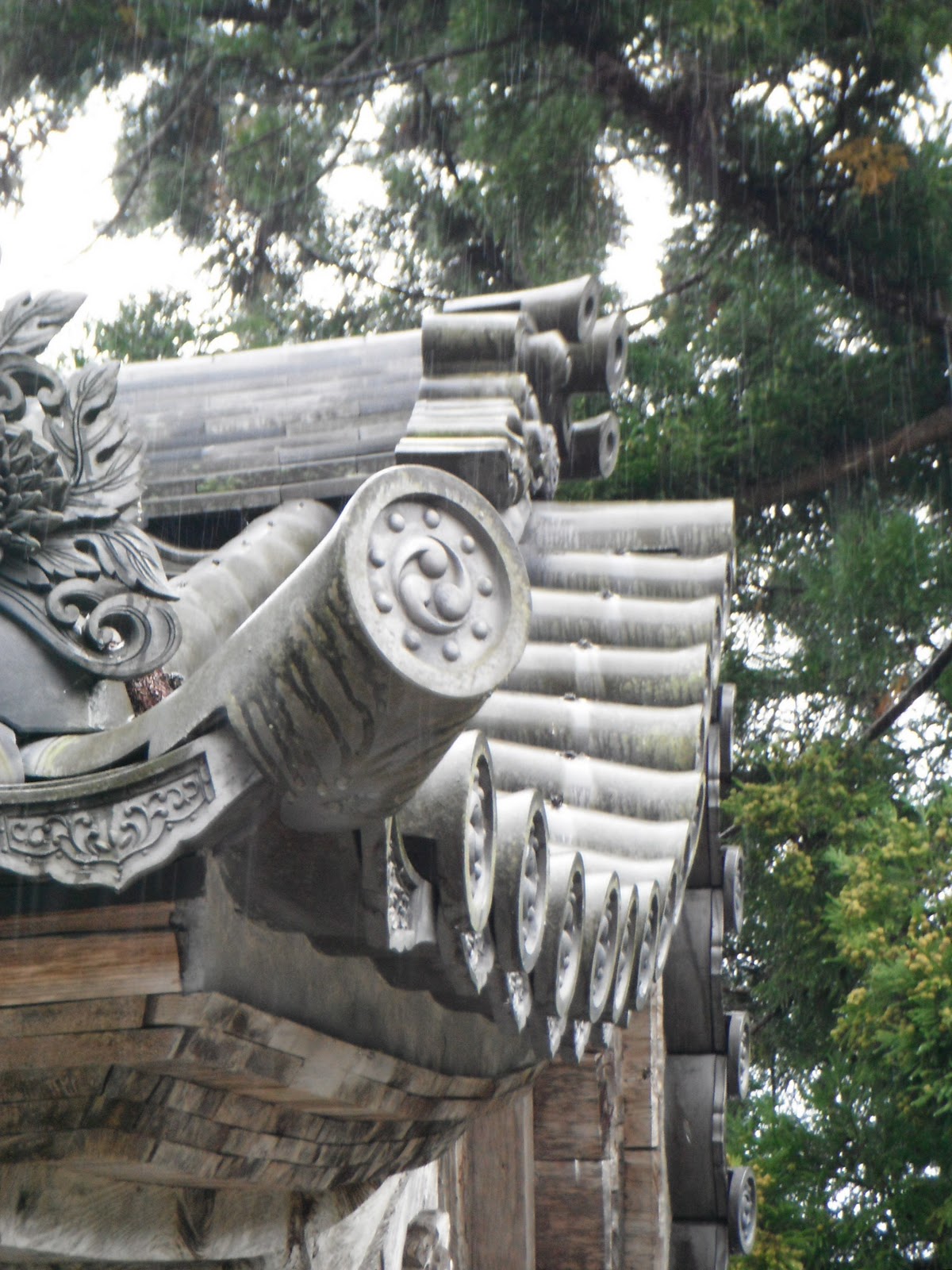
Below are some pictures of the area surrounding Chuson-ji.


After touring the Chuson-ji Temple we headed to a nearby restaurant for lunch.  After eating we headed to another temple in the Hiraizumi area known as the Takkoku no Iwaya Cave Temple.  The temple was commissioned after the emperor Kanmu ordered the warrior-noble Sakanoue no Tamuramaro to lead an attack against the Emishi.  After a successful campaign in 801, Tamuramaro had the temple built  where the Emshi chief, who had terrorized the local population, had lived.  Included on the grounds are the Bishamondo Hall, Benzaitendo Hall and the Sieko-ji Temple Main Hall.


Our last stop for the day was the Motsu-ji Temple.  It was absolutely beautiful.  In order to give some insight into the temple's founding, here is an excerpt from the information page about the temple:

"The temple history records that in the year 850 the great priest Ennin (Jikaku Daishi), the third head abbot of the Tendai sect, was traveling around northern Japan when he became lost in a thick fog in this area and was unable to proceed another single step. 

When Ennin glanced at his feet, he noticed the hair of a white deer lying there beside them. Intrigued, the priest followed the trail of hair to find its owner, a white stag. Ennin approached the deer, but it vanished into the fog. In its place appeared a silver-haired old man who told the abbot, "This is a sacred place. If you build a temple here, the Buddhist law shall surely spread among the people." 

Ennin sensed that this old man was an incarnation of the healing Buddha, Yakushi, and followed his advice. The priest built a hall which he named Kashoji, after the name of that historical period (850 was year 3 of Kasho). And that is the legend of Motsuji's founding."


If you would like a more in depth history of this sight please peruse the following link, Motsuji Temple Information.

While the area was once composed of nearly 40 different buildings and halls, many were destroyed due to fires over the years.  However, the most famous feature of the location is the Pure Land garden.  It is meant to represent the Pure Land of the Buddhist afterlife.  It's construction and design were based on the teachings of the Sakuteiki, Japan's most ancient garden instruction script.  It therefore includes components such as a peninsula, rocky outcrops, bridges, inclusion of the natural surroundings and scenery.  It is an area that truly blends with the natural environment.  A sense of peace and calmness comes over one's self upon entering and the balance between the natural world and the Pure Land of the Buddhist afterlife that the garden represents is profoundly moving.


The next day we woke up and headed to Geibi Gorge, a spot nearby Hiraizumi in Iwate Prefecture.  Here we took a short boat trip up the Geibi Gorge.  The river is paralleled by steep cliff walls on both sides, with foliage clinging to the outcrops and ledges of the rock.  In the river numerous carp could be seen swimming by and along the river were numerous features, To'uhHoh (Cloud Spewing Rock), Bishamon Cave where there is a shrine to the god of treasure Bishamon, and Horse's-mane Rock, and the Great Rock of Geibi.  The changing colors of the leaves and songs from our boat's guide gave a timeless feel to the journey.


Our final stop was in Toyoma Town where we had lunch and visited the historic school house of Toyoma Elementary School, the Police Museum, and walked around the town to view some of the Meiji Era buildings and architecture.  The school itself was built in 1888 and modeled after western styled schools at that time.


After touring the town we boarded the bus and headed back to Sendai.  


The food, culture, history, spirit, and, most of all, the people of the Tohoku region leave one with an unforgettable impression and make the journey memorable and heartwarming.  


頑張ろう東北!


Thursday, October 13, 2011

AIU Festival, Apple Orchards, and Changing Colors

The past weekend was quite the festive one.  If you'll excuse the pun, Akita International University held a school festival over the course of this past Sunday and Monday.  Events consisted of numerous dance performances coordinated by various student clubs, traditional music, local foods,  homemade fashion shows, bands, and a variety of other performances and activities showcasing AIU, student clubs, the community, and culture.  The amount of involvement from the student body was incredible, and many of the students have been preparing for the festival since their arrival at the start of this semester.  The past several weeks, students could be seen rehearsing past midnight and the amount of work and hours put into the preparation for the festival was very impressive.  It was encouraging to see so many student leaders, community members, and faculty collaborating to create something special.  Being someone who values student development theory and the role student involvement plays in creating a positive learning environment, I really enjoyed speaking with many of the students about their involvement and experience.  I also was able to join in on the fun!

I volunteered for the "World Cafe".  We were based in one of the classrooms where we had a variety of teas and treats from around the world that visitors could try for free.  The main focus of our station was we were the final stop for many kids who had been participating in a stamp rally.  They and their families had visited different stops and participated in different activities to gain a stamp.  After attaining three stamps they came to our spot for a prize of candies and some refreshments.  It was also a chance for parents, students, and kids alike to order things in English if they wanted.  I had a great time talking with the kids and community members as well as some friends who stopped by.  The festival was an enormous success and drew in visitors from all over the area.  Including a family from as far as Kyoto!  A good time was had by all!  Below I have posted some pictures of the festival including the World Cafe and the Taiko performance.

However, before I went to the festival, Saturday night a friend of mine, Yuno, and her family, actually the same family that came all the way from Kyoto to see the festival, invited me to come to Akita city with them.  So, on Saturday afternoon I went with them to pick apples in a nearby apple orchard and then to Akita city.  I stayed with them in the E-Hotel (which is a clever name because in Japanese いい, pronounced "ee" means good or great), where I was able to go experience a traditional Japanese style 温泉 (on-sen) (similar to a bathhouse).  Mr. Itoi kindly showed me how to properly enter the onsen and the proper way of doing things.  It was a great experience and very relaxing!  Afterwards we all enjoyed some tea and conversation before heading to bed.

お体に気をつけてください。
終わりました!:)


Saturday, October 1, 2011

誕生日と稲刈り My Birthday and Rice Harvest!

It was quite a busy weekend,  my first birthday in Japan was wonderful.  Thursday morning I started my birthday off right with two Japanese vocabulary tests!  Initially I had nothing planned for the night as I had quite a bit of homework to focus on, however, some of my friends surprised me with a party and cake!  It happened to be both my and my Taiwanese friend Joanna's birthday, so a group of friends planned a party for us, it was so much fun and I was so happy that I was able to spend my birthday with good company.  I have put a few pictures below of the group.  Then, last night I went into Akita city for a fun night consisting of a delicious noodle shop, some karaoke, and of course the famous 秋田の日本酒 (Aki-ta Ni-hon-shu) Akita sake.  As many of you already know, Akita is famous throughout Japan for its delicious rice, and therefore the sake made here is among the best.  Appropriately, after a night of enjoying the final product of many of the surrounding swaying fields of rice, this morning I woke up early to participate in a traditional rice harvest.  So, I can now truly appreciate how much work goes into the sake and rice I have been able to enjoy!

The harvest was a fantastic experience!  I of course took my tree farming and hay bailing skills with me and was ready to be a hard working representative of the States.  It turns out rice harvesting is quite different than bailing hay :P  Initially, I had a struggle learning how to do the special wrap, roll, spin and twist motion in order to tie the stalks together.  However, after some help from some very patient farmers, I caught on to it and now many of my peers and a few of the faculty that were with us on the trip are convinced that in a previous life I was a professional rice harvester.  I was very excited when, halfway through the harvest, the local farmers gave me a smile and nod of approval and asked me to help teach a few of the other students!  This of course would not have happened if it hadn't been for the very, very patient farmer who helped get me into the swing of things.

The process itself is called 稲刈り(ine-ka-ri).  You start by cutting three groups of rice stalks at the base and then laying them together with the bottoms of the stalks propped on a previously cut base.  Then you cut another group of three and lay them over the other stalks at a slight angle.  This part is simple.  However, then you select three individuals stalks and use them to tie the base together in a special motion which keeps the ends all pointing the same direction.  It is hard to explain but it is really a neat thing to watch. After harvesting the field you then take each bushel and hang it to dry.  In a few weeks the rice will be ready to process and we will go back to take part in the last steps of the process.  The rice that we all harvested today will actually be given to us when we finish the process, so we will have the chance to taste fresh rice!  It was a wonderful experience and eye-opening as well.  It is quite amazing to see how much labor goes into the process, as I mentioned in a previous entry, to see the balance between the harmony with nature and the struggle in contending with it is a special and humbling experience.


I really have absolutely loved going out into the small farming communities in the surrounding area.  It has been such a great experience.  I am so thankful to everyone who has helped me along the way in getting here, for all of my friends who have made me feel at home here, to the faculty and staff, and to the local community members who have shared their culture with me.  Thank you everyone for your kindness and support.

Thursday, September 29, 2011

My Host Family

This weekend I visited my Host Family's home in Akita.  While I live on campus, Akita International University offers a program through which International Students are paired with a local Japanese family, who act similar to host family.  I am participating in the program and am paired with another international student, Alina.  We both met our family, an older son and his mother, two weeks ago at a meet and greet event.  Watanabe san is a local artist and writer.  This past weekend was the first time that we went and did something together.  We first visited the Mount Taihei Miyoshi Shrine, where we were able to do what is called さんぱいする, the action of ringing the bell and praying.

We then went to Watanabe san's house which was designed by his grandfather and was built in a traditional Japanese style.  His mother greeted us wearing a traditional Japanese Kimono and made us delicious tea!  After drinking tea and talking for a bit she invited us into the adjacent room, where she played the Koto for us.  It was such a treat!  She will be playing in a concert this upcoming January, which we will plan on attending.  After enjoying another cup of tea we headed out on foot into Akita city.  We enjoyed a stroll through a lovely park on the way to the city and  stopped at an Ikebana (Japanese flower arrangement) exhibition.  The delicate flower arrangements were very impressive and ranged from both traditional and modern styles.  We also visited several different art exhibits in the city which were all part of an art exhibition of 詣展 (moudeten) in which many local artists participated, including Watanabe.  The style consists of a square pine box inside which the artist creates a scene or display.  I wasn't able to take any photographs of them, however if I find some I will post them in a following blog.  If you would like to see some of Watanabe san's work, the following is an address to his website: http://peace-flower.one-traveler.info/gengaten.

After stopping by the various galleries, we returned back to Watanabe san's house where we watched the final stages of a Sumo tournament.  お母さん (Okaasan "Mother") was very happy when her favorite won the tournament!  It was quite a thing to see, if one wins a Sumo tournament you get a number of impressive trophies, enough to justify not just a trophy case, but a trophy room!  Very impressive!
I don't think I would be a very strong competitor though, so I will stick to my studies. :)

Below are some pictures of the day.


Monday, September 19, 2011

An Update On Everyday Life

So, now for the weekend update!  Things are going well!  After receiving a few varying questions on the day to day life I will talk a bit on the daily routine.  I have really been enjoying a newfound passion in cycling about the area.  It is a really nice way to explore and discover some of the less known and hidden gems of the Akita area.  Drivers here are very courteous to cyclists and bikes in general.  Many roadways actually have designated sidewalks for bike traffic, and many of the country and mountain roads in the area are paved.  It has been quite an adjustment learning to look the opposite way for traffic!  I always have to take a bit longer than the locals when making right hand turns or crossing the street.  I also recently saw a カモシカ pronounced ka-mo-shi-ka, while I was returning from a bike ride, I included a picture from the internet since I was not able to take one myself.  It is a native species to the area and when I first saw it, not knowing what it was, I decided to get off the bike and wait until the path was clear.
I have also been working out routinely.  The gym here is quite small, but they have kettle bells (similar to a cannon ball with a handle on it) which are a great way to get a good workout and I am very happy to see them, as I learned to use them at Bonneville.  The school is actually about 20 minutes away from 秋田Akita City by bus and train, so many times students head there on the weekends.  This past weekend I went with a group of friends to try the very popular activity known as Karaoke.  I don't think I will become a professional singer anytime soon, but it certainly was fun!  I have also enjoyed trips to the grocery store, looking at the variety of different snacks and fish they have here is very interesting.
During the week I am quite busy with homework and studies.  Thus, I have become very familiar with the library.  I have Japanese vocabulary tests everyday, so each night I have upwards of 40 new words and kanji to learn, this is good though because I am able to practice often.  Classes are difficult but the quality of the faculty and class size is excellent and I am up for the challenge!  I also keep a notebook with me at all times so that when I hear a new phrase or word from my friends I can write it down.  I often make my roommate and friends laugh by making funny sentences, such as 割引券を忘れちゃった!wa-ri-bi-ki-ken o wa-su-re-cha-tta.  "I forgot my discount coupon why!".


Recently it has been raining quite a bit, and it seems that another typhoon may be approaching.  All is well here though.  The fall is fast approaching and the leaves will soon be changing, I am looking forward to the changing colors!

ジェフ
Jeff

Below are a few pictures from the past few weeks.  The karate pose picture is from a walk I took around the area with my friends.  The one of the big group is from a potluck that was held over the weekend.  The animal in the snow is a Kamoshika.  The last one is one of my roommate Yota.


Saturday, September 10, 2011

Kakunodate Festival

This past Thursday I was invited by some friends to go to the Kakunodate Festival.  It is in an old samurai town about an hour and half from Akita International University.  Kakunodate has been callled a "little Kyoto" as its appearance and samurai district give it a similar feeling.  The festival itself takes place for three days, and the displays include massive wooden Mukashi, these are in the pictures above.  There are various Mukashi that hold drummers, fan dancers, and warriors as well as samurai figures decorating the top platforms.  The Mukashi are pulled with massive ropes and pushed by a large team of people.  At certain points, they smash into one another over and over!  At other points the Mukashi are tilted upwards into the sky and pulled against each other in a sacred competition to honor the gods with the sweat of the warriors, and the competition can last for hours.  It is hard to describe with words, but the amount of strength and the scale of the event was amazing.  The friends I went with are all graduate students at AIU working to complete a program so that they can become Japanese teachers.  They all were so kind in taking me and I am so grateful for getting the chance to go with them.


I also recently took a bike tour of the surrounding area!  I am so glad that I was able to bring a bike with me as it has been very fun getting out into the countryside and covering so much ground so quickly!  I have really been impressed with the difference a road bike makes when biking on the road.  I suppose that is why it is designed for and aptly named after a road.  In any case, I have found a large loop that goes out into some small rice farming communities and follows a large river.  It is quite beautiful.  I have put some pictures of a few resting spots above.  The rice fields, tanbo, are so peaceful to ride by and there are many small paved roads that wind up into the surrounding forested hills.  I usually take a long ride two times a week and venture out into uncharted territory!  The houses here are beautiful.  Many if not most have ornate and well kept gardens and many house are beautifully wrapped with stone or wooden walls surrounding them.  I really enjoy riding through the farming communities as the atmosphere is so calming.  It is also very eye opening to think about the amount of hard labor and the life's work that goes into caring for a single rice field.

There is a unique and subtle balance that exists here, and it truly is beautiful.

ジェフ

Thursday, September 1, 2011

Noh and the Surrounding Area


It has been a busy week preparing for school and finishing up my orientation.  I have already been able to learn many useful expressions and am looking forward to my Japanese coursework.  I will be taking one core Japanese class as well as four specialized Japanese classes, Kanji Foundations, Reading, Calligraphy, and Pronunciation.  I will also be taking an Economics of Globalization class as well as a class on Ikebana (Japanese flower arrangement).  I am very excited to get started!  Last night there was information on some of the student clubs available on campus, I am hoping to participate in at least one or two.  Specifically I have signed up for the Japanese Conversation club as well as a Service club which volunteers in the local community.  These will be great ways of engaging in my environment and learning more about the area.  In regards to this past weekend, I was able to go see a Noh play on Sunday.  Noh is a traditional Japanese theatre style.  As, many Noh plays can last for an entire day what I saw only lasted about three hours.  Noh style is typically broken into two pieces, with a short humourous play in-between named a kyougen.  The costumes were very ornate and accompanied the unique movements of the characters well.  I was not able to photograph anything during the play, but above I have posted a picture of the stage.  I have also posted some pictures from various places surrounding my school.  If you would like to know more about Noh, I am certainly not an expert (though we were able to listen to a very interesting lecture on the subject before going) and don't want to speak too much on a subject that I know too little about, but it has a deep connection with Japan's history and its origins are very interesting, so if you get a chance to look into it it's well worth it! :) Currently we are expecting a Typhoon, so it has been very humid and is starting to rain heavily.  It will be fun to watch :)

終わりました!